
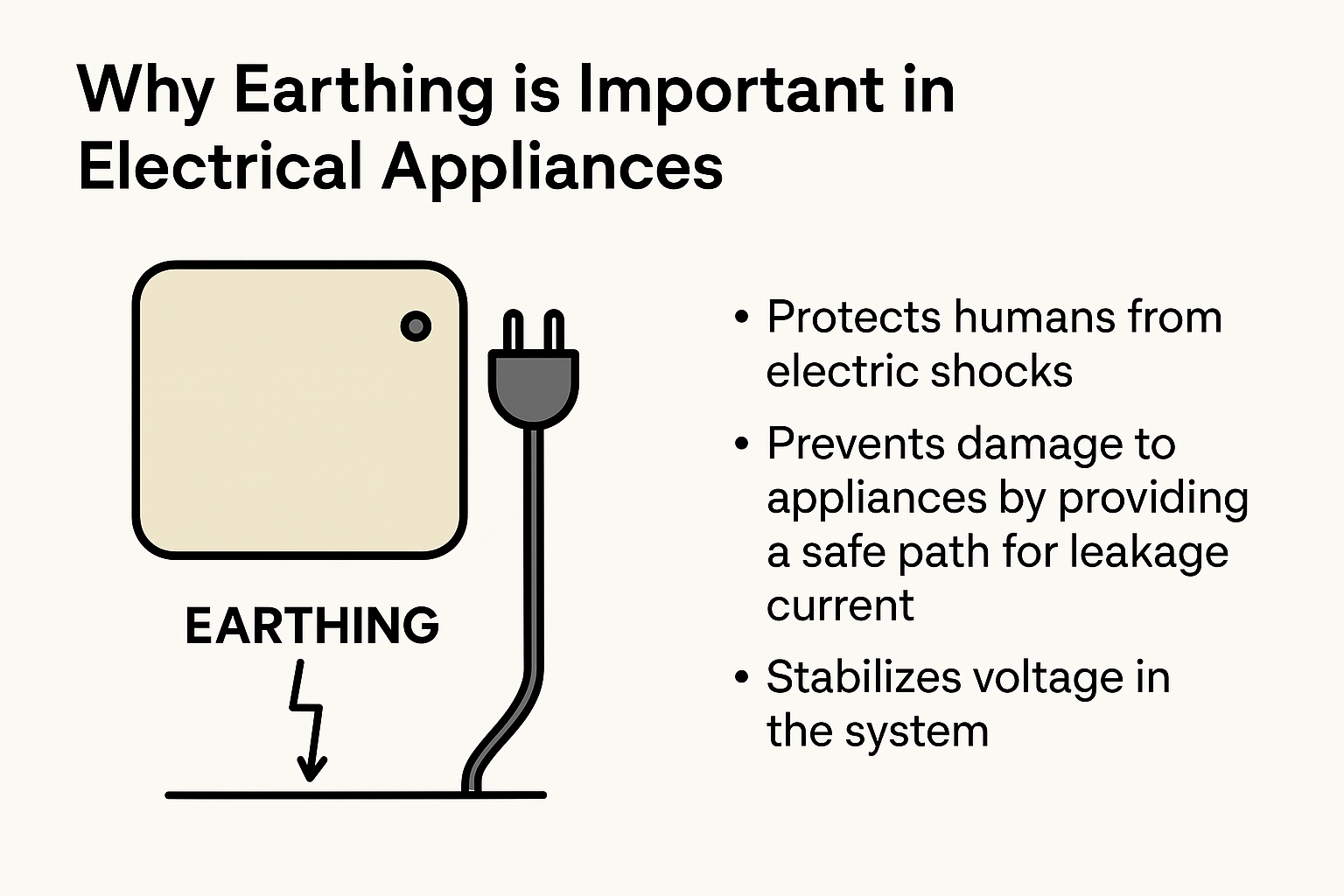
Earthing (or grounding) is a vital safety measure in electrical systems. It ensures that any leakage of current from faulty wiring, insulation failure, or damaged appliances is safely directed into the ground instead of passing through the human body.
When an appliance is properly earthed, its metallic body is connected to the earth using a low-resistance wire. If live wire insulation breaks and touches the metal body, a large current flows directly to the ground. This sudden surge of current causes the fuse or circuit breaker to trip, disconnecting the supply and preventing electric shock.
Without earthing, the metallic body of the appliance may remain at a dangerously high potential. Anyone touching it could complete the circuit and receive a severe electric shock. Earthing also helps in stabilizing voltage levels and protects sensitive equipment from voltage fluctuations or lightning strikes.
In summary, earthing is essential because it:
- Protects humans from electric shocks.
- Prevents damage to appliances by providing a safe path for leakage current.
- Stabilizes voltage in the system.
That’s why every household and industrial electrical system must be properly earthed for safety.